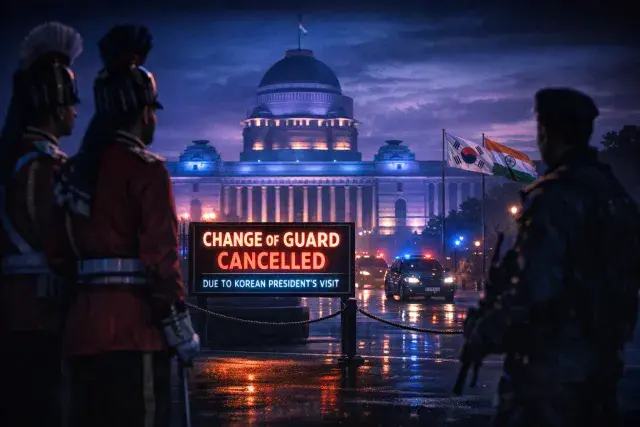
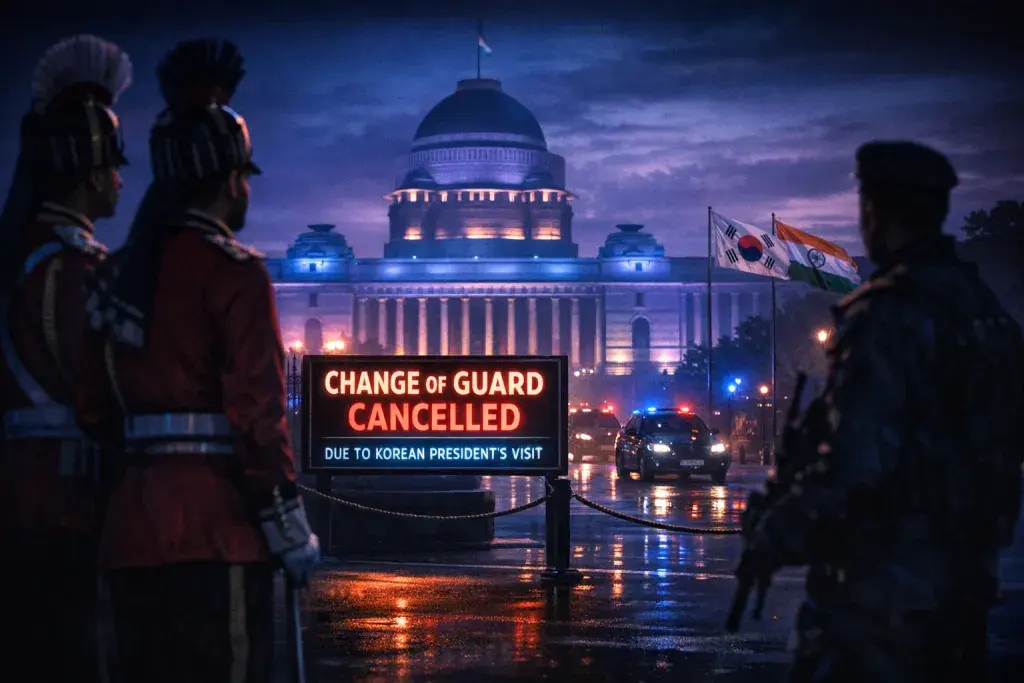
New Delhi's iconic Change of Guard Ceremony at Rashtrapati Bhavan skips its regular Saturday slot on April 18 due to rehearsals for the upcoming state visit of the Republic of Korea's President. An official from the President's Secretariat announced the suspension on Thursday, highlighting the priority given to diplomatic preparations. This adjustment underscores the residence's dual role as a ceremonial hub and a center for international diplomacy.
Regular Schedule and Occasional Disruptions
The ceremony normally unfolds every Saturday from 8 a.m. to 9 a.m. in the Forecourt of Rashtrapati Bhavan, drawing visitors to witness the precise handover among presidential guards. Officials cancel it on gazetted holidays or when advance notice specifies otherwise, as with this instance tied to the Korean state visit. Recent precedents include the suspension of public visits to the Rashtrapati Bhavan Main Building (Circuit-1) from January 21 to 29 for Republic Day events, reflecting a pattern where national priorities temporarily override public access.
A Architectural Marvel with Deep Historical Roots
Conceptualized in 1911 after Britain's capital shift from Kolkata to Delhi, Rashtrapati Bhavan began construction in 1912 under architect Edwin Lutyens and opened in 1929 after 17 years. This H-shaped mansion covers 5 acres within a 330-acre estate, boasting 340 rooms across four floors and 2.5 kilometers of corridors. Its design fuses Indian motifs—like a dome inspired by the Sanchi Stupa, chhatris, and jali work—with imperial scale, evolving from Viceroy's House to Government House at independence in 1947, then Rashtrapati Bhavan under President Rajendra Prasad.
Attractions and Ceremonial Significance
The Main Building welcomes public viewings Tuesday through Sunday (barring gazetted holidays) in seven slots from 9:30 a.m. to 4:30 p.m., while the Rashtrapati Bhavan Museum Complex operates on the same schedule with online booking. The 15-acre Amrit Udyan garden, opening February-March, captivates with flowers, trees, and fountains amid urban bustle. Beyond tourism, the estate hosts defence investitures, leader swearings-in, treaty signings, and celebrations for Independence Day and Republic Day, cementing its status as a symbol of India's heritage and democratic continuity.