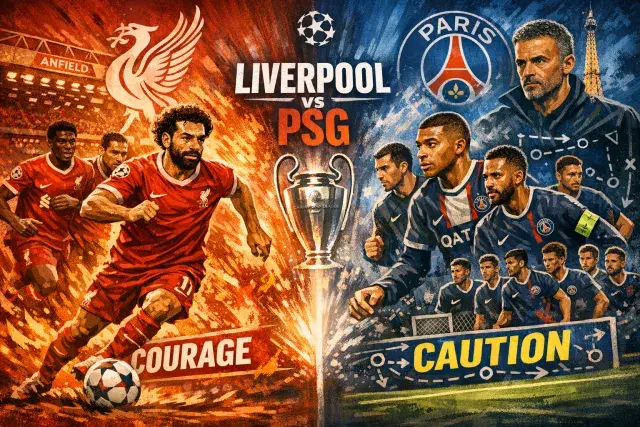
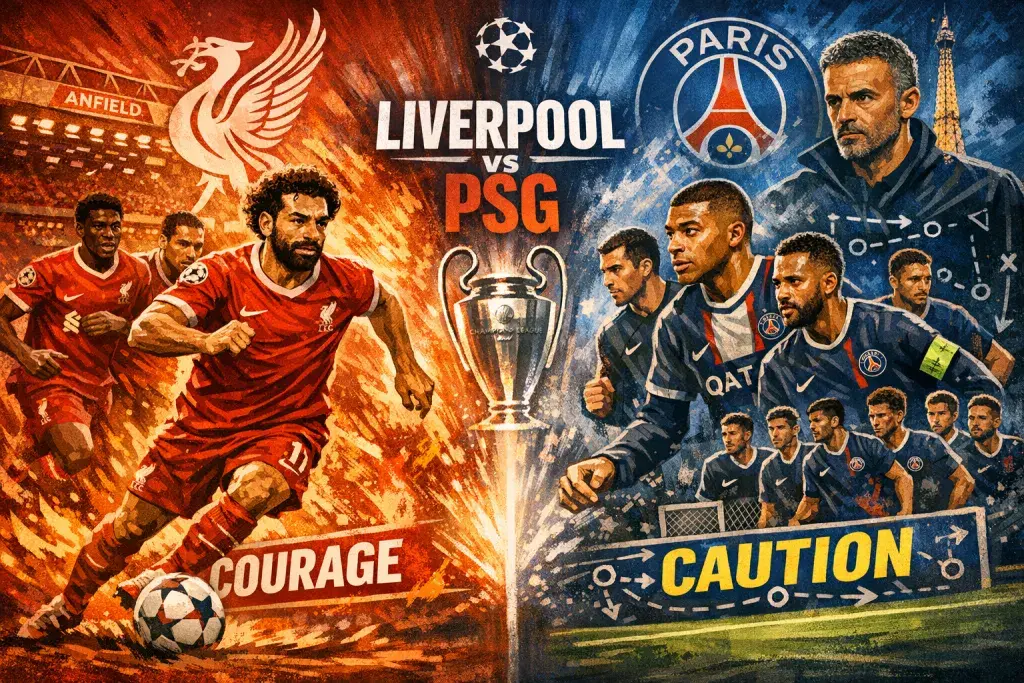
Liverpool remain in contention in this season's Champions League by the narrowest of margins, having returned from Paris with a 2-0 defeat that, given the scale of their performance problems, was widely interpreted as something approaching a reprieve. The second leg, at Anfield on Tuesday, represents one of the most consequential occasions of Arne Slot's tenure — a night on which tactical timidity is not a viable option.
A Performance That Demanded Answers
Whatever the post-mortem language used in the days since, the evidence from the first leg was unambiguous. Liverpool completed just 190 passes over the course of the evening, compared to PSG's 685. They registered nine touches in their opponents' box and failed to produce a single clear opportunity of note. These are not the statistics of a side that was unfortunate, pressed back by misfortune, or undone by a single moment of brilliance. They are the statistics of a side that arrived in Paris without any apparent intention of imposing themselves on the contest.
Slot deployed a five-man defensive structure — a formation he had not used at any point in the 18 months prior — and the results were predictably disastrous. Even Virgil van Dijk, one of the most authoritative central defenders of his generation, struggled to maintain any defensive coherence against a PSG forward line that moved with the kind of fluidity that punishes rigid, passive structures without mercy. Ibrahima Konaté came close to conceding two penalties. Florian Wirtz showed promise in possession but could rarely find the ball in meaningful areas. Dominik Szoboszlai looked uncertain of his own role. The system, in short, failed everyone deployed within it.
What the Second Leg Actually Requires
Slot has vehemently defended his Paris approach in public. The private calculus, however, is different now. Liverpool require a two-goal margin to advance, and PSG, who were wasteful in France, are unlikely to be so accommodating again. Luis Enrique's side also have recent experience of performing at Anfield — they won a penalty shootout there last season — which means the psychological weight of the occasion carries less force as a deterrent than it might against unfamiliar opposition.
The most straightforward tactical conclusion is one that several observers have reached independently: Liverpool must revert to a flat back four and restore Mohamed Salah to the starting line-up on the right wing. Salah's broader form this season has been inconsistent, but his record of direct involvement in 20 goals across all competitions tells a more complete story, as does his pivotal contribution to the 4-0 second-leg victory over Galatasaray in the previous round. Benching him against PSG in the first leg did not solve the problems that had accumulated before it — it merely removed one of the few credible sources of attacking danger from the equation.
At right-back, the case for starting Jeremie Frimpong ahead of Joe Gomez is built on a single but significant factor: pace. PSG's wide forwards are among the fastest and most direct in European football, and Frimpong's speed gives Liverpool at least a functional defensive response to that threat while simultaneously providing an overlapping outlet for Salah. Against Fulham most recently, Frimpong created three chances — more than any other individual on the pitch. Gomez, a more conservative option, might reasonably displace the erratic Konaté alongside Van Dijk if Slot wants to shore up the centre while still trusting Frimpong in the wider right role.
Ngumoha and the Question of Youth Under Pressure
The most intriguing selection decision concerns the 17-year-old Rio Ngumoha. Slot has managed the teenager's involvement carefully throughout the season, conscious of the well-documented risks that come with overloading young talents in a modern footballing calendar that offers almost no natural rest. That caution has been entirely defensible. But Tuesday represents a different kind of calculation.
Since a striking cameo off the bench at Nottingham Forest in February, Ngumoha has been one of the most compelling figures in Liverpool's attacking options — a direct, fearless dribbler whose instinct, as Slot himself has acknowledged, is to go straight at his opponent rather than away from trouble. His recent solo effort, which made him the youngest Premier League scorer at Anfield in the club's history, drew comparisons with a young Raheem Sterling and appeared to resolve whatever hesitation Slot had about exposing him to the highest level of European competition. "He's ready," the head coach said on Saturday. "He's just someone I can pick for any game."
Cody Gakpo, the other natural candidate for a wide forward role on the left, has not done enough this season to make a compelling case for inclusion in a contest of this magnitude. Hugo Ekitike, returning from injury, is the expected starter through the centre. The more imaginative option would be to use the returning Alexander Isak centrally and push Ekitike wider left — a combination that would give Liverpool a different kind of movement and a more varied threat than they have shown in recent weeks. Whether Slot has the appetite for that level of reconfiguration, with everything at stake, remains the defining question of his week.
Bravery as the Only Realistic Strategy
At left-back, Andy Robertson's experience in high-pressure situations gives him a narrow edge over Milos Kerkez, particularly given concerns about Kerkez's recovery time across three fixtures in the space of a week. Robertson's seniority could also benefit Ngumoha, who may find more security with an experienced presence beside him as he navigates what would be the most demanding occasion of his short professional career.
The broader point, however, transcends any individual selection decision. Liverpool's survival in this competition has so far owed more to PSG's profligacy than to anything Slot's side has done to merit it. The second leg cannot be approached with the same defensive logic that produced one of the most passive performances of the Slot era. The Anfield crowd will not accept a repeat, and the arithmetic of the tie does not allow for one. Slot must commit to an approach that reflects the actual quality available to him — and trust that the attacking talent in his squad, freed from structural constraint, is capable of producing the kind of performance that the occasion demands.